 (Image source: Gemini)
 We’ve entered the era of the Software-Defined Vehicle, or SDV. This shift means that the code running under the hood is just as important as the pistons or the battery cells. By the end of last year, the market for these software-centric cars grew to over 7.6 million units.¹ It’s a massive change in how we think about transportation. So what does this actually mean for you when you’re behind the wheel? It’s not just about having a bigger screen for your maps. The real magic is happening in two main areas: keeping you alive and making every drop of fuel or kilowatt of power count. We’re looking at a future where accidents become rare and "range anxiety" is a term for the history books.
Introduction and the Tech-Driven Evolution of Modern Driving
If you’ve looked at a new car lately, you’ve probably noticed it feels different. It’s because manufacturers are moving away from hardware-centric designs. In the past, if you wanted a better safety feature, you had to buy a brand-new car. Now, your car can literally get better while it’s parked in your driveway overnight.
The dual focus of this evolution is pretty simple. First, we want to stop crashing. Second, we want to stop wasting energy. It sounds basic, but the tech required to do both at the same time is incredibly complex. We’re talking about a blend of AI, lightning-fast sensors, and constant cloud connectivity.
This isn't just about luxury anymore. These innovations are trickling down to mid-range sedans and SUVs faster than ever. The goal is a seamless, sustainable experience where the car does the heavy lifting, leaving you to enjoy the ride without the stress of traditional driving.
Advanced Driver Assistance Systems (ADAS) and the Digital Co-Pilot
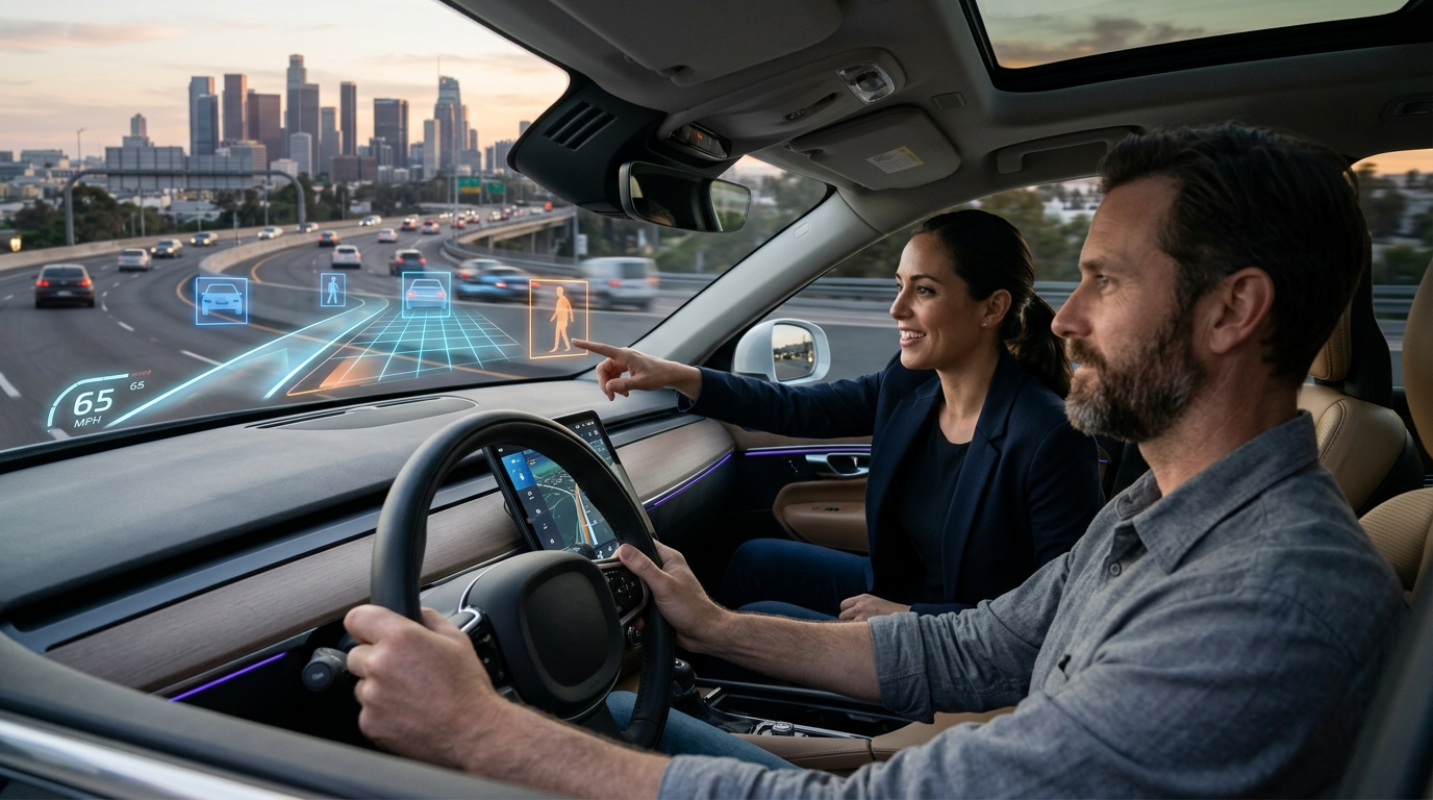
You can think of ADAS as your digital co-pilot that never gets tired or distracted. It’s the evolution of features you’re already used to, like Automatic Emergency Braking (AEB) and Lane Keep Assist. But these systems have grown up fast. Just a decade ago, only about 12% of cars had forward collision warnings. By 2024, that number hit 94%.¹
So how does the car actually "see" the world? It uses something called sensor fusion. This is the digital equivalent of having eyes, ears, and a sixth sense all working together.
- Cameras: These act as the eyes, reading road signs and spotting pedestrians.
- Radar: This uses radio waves to determine how far away objects are and how fast they’re moving, even in heavy rain or fog.
- LiDAR: This is the heavy hitter. It uses laser pulses to create a 3D map of everything around the car with incredible precision.
Last year, we saw a big jump in Level 3 autonomy. Mercedes-Benz and BMW both secured certifications for systems that let you take your eyes off the road in specific highway conditions. Even Waymo expanded its "eyes-off" robotaxi service to 10 more U.S. cities. The safety impact is real. Data from fleet trials shows that systems like GM’s Super Cruise have cut accidents by up to 40%.¹
Connected Vehicle Technology and V2X Communication
Have you ever been stuck at a red light when there’s absolutely no one else at the intersection? It’s frustrating and a total waste of energy. Vehicle-to-Everything (V2X) communication is designed to fix exactly that. It allows your car to "talk" to the world around it.
This includes talking to other cars (V2V), talking to traffic lights and stop signs (V2I), and even spotting pedestrians through their smartphones (V2P). Starting in early 2025, models like the BMW 5 Series began shipping with integrated V2X technology.²,³ This allows the car to give you a heads-up about a red-light runner before they even enter your field of vision.
The U.S. Department of Transportation thinks this tech is a literal lifesaver. They estimate that V2X could reduce road fatalities by up to 80%. It’s not just about safety, though. When cars talk to traffic lights, they can optimize their speed to hit "green waves," which reduces idling and keeps traffic flowing smoothly.
In places like China, this is already becoming the norm. Projections showed that over half of all new vehicles in major Chinese cities would be V2X-equipped by the end of 2025. It’s the digital infrastructure that turns a lonely car into part of a smart, coordinated hive.
Efficiency Gains Through Predictive Powertrain Management
Efficiency used to be about aerodynamic shapes and lightweight materials. Although those still matter, the real gains are now coming from AI. Predictive powertrain management uses real-time data to decide exactly how to use the car’s energy.
Think of it like a world-class marathon runner who knows exactly when to sprint and when to coast based on the hills ahead. If your car knows there’s a steep climb coming up in two miles, it can adjust the battery usage or engine mapping ahead of time to stay efficient.
- Smart Route Planning: The car looks at topography, weather, and traffic to find the path that uses the least energy.
- Thermal Management: New heat pumps, like those from Hanon Systems, harvest waste heat from the motor and battery to keep the cabin warm. This can significantly boost an EV's range in freezing weather.⁴
- Battery Longevity: AI-optimized Battery Management Systems (BMS) are now extending the life of EV batteries by up to 40%.⁴ They do this by predicting and preventing the tiny patterns of degradation that happen during charging and discharging.
These systems can lead to a 20% improvement in fuel economy for gas cars and up to a 15% range boost for electric vehicles. It’s the difference between driving hard and driving smart. Even heavy-duty engines, like the Cummins X15, are using these digital tools to minimize downtime and get the most from every gallon of diesel.

.jpg)